
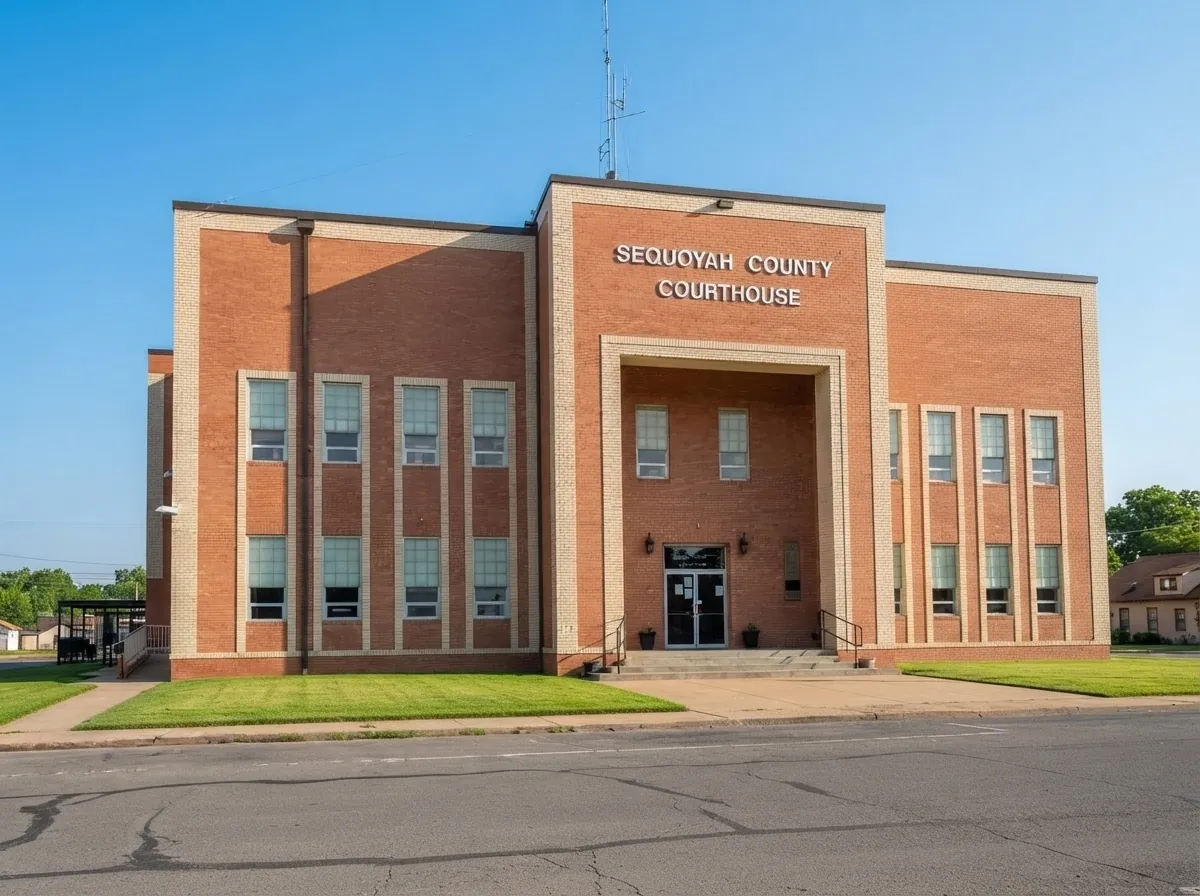
Court records of Sequoyah County in the state of Oklahoma are maintained by the district court clerk and are accessible through official court portals, the clerk's office, and online tools. SequoyahCourt.us will help you navigate the publicly available court information of this county. Additional access points include the On Demand Court Records portal, the clerk's office in the courthouse in Sallisaw, and resources from the Oklahoma Department of Libraries for legal self-help.
Sequoyah Court System Overview
Sequoyah County is part of the 15th Judicial District of Oklahoma, which also includes Cherokee and Wagoner counties. The District Court is a court of general jurisdiction and handles criminal, civil, family, probate, and juvenile cases. The magistrate division operates in the same building and processes less severe categories of cases. The courthouse is located in Sallisaw, the county seat.
Courts Serving Sequoyah
| Court | Address / Contacts |
|---|---|
| Sequoyah County District Court (15th Judicial District) | 120 East Chickasaw Avenue |
| U.S. District Court — Eastern District of Oklahoma | 101 North 5th Street |
| Sallisaw Municipal Court | City of Sallisaw |
Federal bankruptcy cases for this region are handled by the U.S. Bankruptcy Court, Eastern District of Oklahoma, in Okmulgee.
What Types of Cases Sequoyah Courts Hear
The county courts hear a wide range of cases:
- Criminal — felonies, misdemeanors, traffic violations, DUI
- Civil — claims of any amount, small claims
- Family Law — divorce, custody, child support, protective orders, paternity establishment
- Probate and Guardianship — estate probate, guardianship, conservatorship
- Juvenile — cases involving minors, child protection, adoption
District Court Cases in Sequoyah
The District Court hears felonies after a preliminary hearing in the magistrate, civil claims exceeding the jurisdictional limit of the magistrate division, and appeals from magistrate decisions. Cases reach here either through an information/indictment or by transfer from the magistrate level. The district court judge presides over jury and non-jury trials. Case distribution among judges is according to the internal rules of the 15th Judicial District. Federal crimes committed in the county are transferred to the Eastern District of Oklahoma.
Magistrate Court Cases in Sequoyah
The magistrate division is the first stop for most residents. It handles misdemeanors, traffic violations, DUI cases at the arraignment stage, and conducts preliminary hearings in felony cases. Civil claims up to $10,000 and small claims up to $10,000 under Oklahoma law also fall under the magistrate's jurisdiction. If the judge finds sufficient evidence at the preliminary hearing, the case is transferred to the district court level.
Family Law, Probate, and Juvenile Matters in Sequoyah
Family Law. Divorce, child custody, child support, protective orders (VPO), paternity establishment, and termination of parental rights are all filed with the district court clerk's office. Marriage and divorce statistics by county are published by the Oklahoma Department of Health.
Probate Matters. Estate probate, appointment of guardians and conservators, and trust matters are all handled by the district court. To open a probate case, a petition must be filed with the clerk along with a copy of the death certificate.
Juvenile Matters. Cases under the Juvenile Corrections Act and Child Protective Act are confidential. Access is limited to parties involved, attorneys, and authorized agencies.
How Cases Move Through the Sequoyah Court System
- Filing. A criminal case begins with a complaint or indictment; a civil case with a petition. Documents are filed with the district court clerk.
- Judge Assignment. The case is assigned to a judge according to the internal procedures of the 15th Judicial District.
- Initial Hearing. In criminal cases — arraignment; in civil cases — scheduling conference.
- Pretrial Stage. Motions, discovery, plea negotiations, or settlement discussions.
- Trial. Jury trial or bench trial, plea agreement, settlement, or default judgment.
- Post-Judgment. Sentencing, appeal to the Oklahoma Court of Civil Appeals or Court of Criminal Appeals, enforcement of judgment.
Court Administration, Local Rules, and Public Access in Sequoyah
The administrative judge of the 15th Judicial District is responsible for workload distribution among judges and overall management. Local district court rules define filing deadlines, hearing procedures, and formatting requirements. Legal information for Oklahoma residents, including forms and instructions, is published by the State Department of Libraries.
Most court records in Oklahoma are public under the Open Records Act (51 O.S. § 24A). Exceptions include juvenile cases, sealed records, certain child protection documents, and records closed by court order. To obtain copies, contact the district court clerk; a fee is charged for certified copies.
Hearings are usually held in person at the courthouse in Sallisaw. In certain case categories, the court may allow remote participation — check with the office for details.
Court Records and Related Court Resources in Sequoyah
- Online Case Search. The On Demand Court Records portal allows viewing case information from several Oklahoma counties, including Sequoyah.
- County Public Records. The Sequoyah County Court Records page gathers contact information for the county assessor, clerk, and treasurer.
- Warrant Search. To check active warrants, contact the sheriff's office or use the Oklahoma Warrant Search page.
- Inmate Search. The Oklahoma Department of Corrections provides a database of inmates across the state, including those from Sequoyah County.
- Vital Records. Birth and death certificates are issued by the Office of Vital Records at the Department of Health. Marriage and divorce certificates are issued by the county court clerk where the application was filed.
- Land Records on Tribal Lands. For plots on Indian reservations, records may be maintained by the Bureau of Indian Affairs — Branch of Land Titles and Records.
- Unclaimed Property. Check for unclaimed funds through the Unclaimed Property Division of the Oklahoma Treasury.
- Legal Self-Help. Application forms, instructions, and links to free legal aid are compiled on the Legal Information for Oklahomans website.